

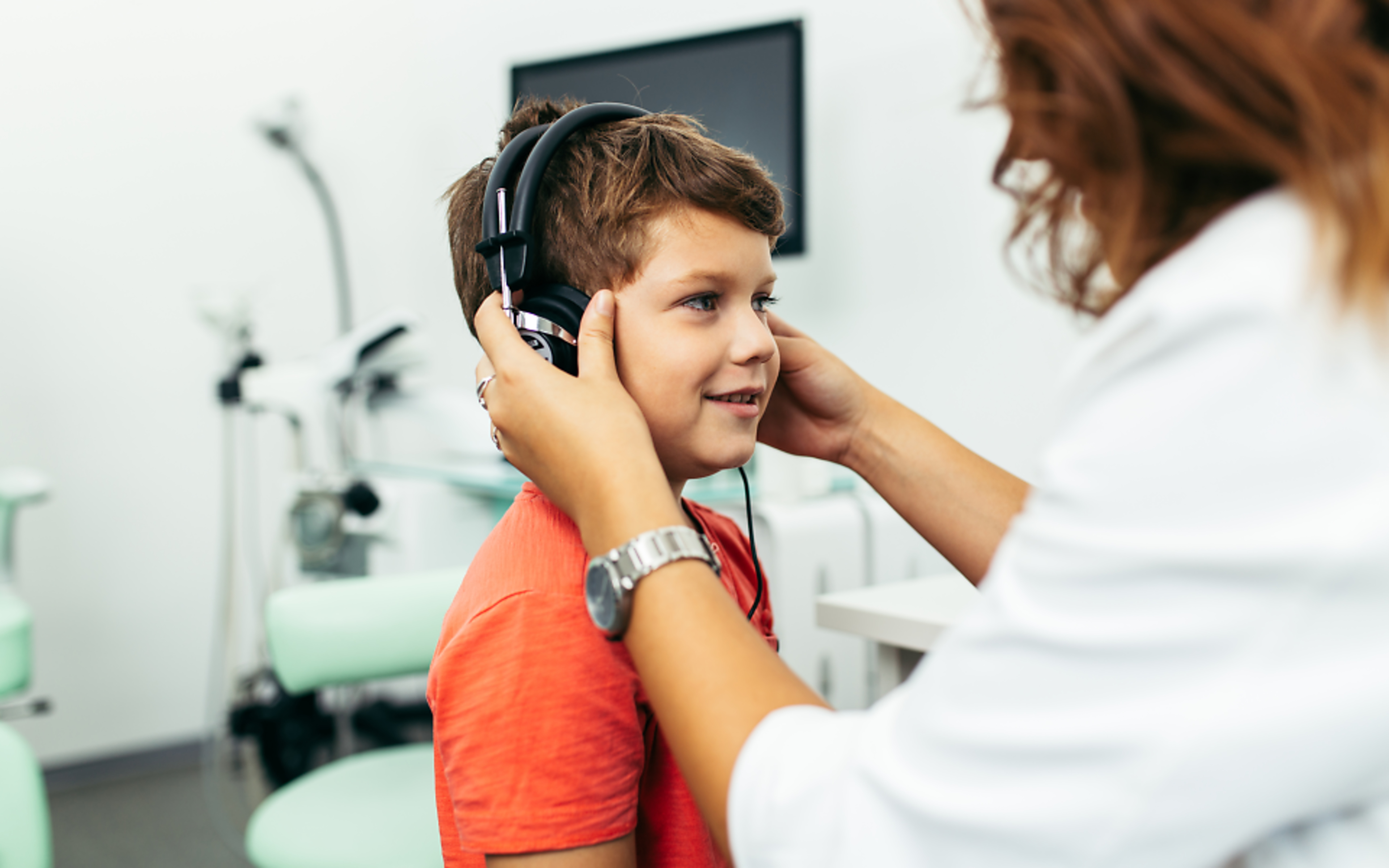
The Center for Perception and Communication in Children (CPCC) at Boys Town National Research Hospital (BTNRH) has been awarded a $6.1 million National Institutes of Health (NIH) Centers of Biomedical Research Excellence (CoBRE) Phase III grant.
Established in 2014 through NIH National Institute of General Medical Sciences (NIGMS) and Phase I and II CoBRE funding, the CPCC strives to improve the lives of children with communication disorders through groundbreaking research, innovation and scientific collaboration.
"This award recognizes the tremendous accomplishments of our investigators and affirms our vision for the future," said Lori Leibold, Ph.D., Program Director of the CPCC.
"Phase III funding will strengthen our research infrastructure, support scientific discovery in Nebraska, and expand our ability to answer critical questions that support children’s development of communication skills.”
CoBRE grants like these are part of the Institutional Development Award (IDeA) program, which is designed to strengthen biomedical research capacity in states that historically receive lower levels of NIH funding, including Nebraska.
Addressing Critical Needs
Approximately one in 12 children in the United States experiences a speech or language disorder, more than 6,000 infants are born annually with permanent hearing loss, and most children experience at least one ear infection during early childhood.
These conditions and disorders can impact children's ability to learn, build relationships, express themselves, and succeed in school and beyond.
To address these needs, Boys Town strives to become one of the nation's leading centers for research focused on speech, language, hearing, and cognitive development in children with communication disorders.
A Dozen Years of Progress
Over the past 12 years, CPCC-supported projects have produced over 70 publications and helped bring in millions in external funding for Boys Town researchers.
The impact is significant, according to Ryan McCreery, Ph.D., Vice President of Research at Boys Town.
“Since 2014, funding for the Center for Perception and Communication in Children has provided Boys Town with funding to recruit early-career scientists and develop shared research resources,” he said.
“The CPCC will continue to shape the future of our research program to help maintain our reputation as an international leader in hearing and language research.”
Past CPCC projects include studies on the efficacy of early intervention in children with hearing loss, individual differences in word learning and memory, and the differential diagnosis of otitis media.
“Research is one of the most powerful ways we can improve the health and wellbeing of the children we care for at Boys Town Hospital. The discoveries made through the Center for Perception and Communication in Children support our mission to change the way America cares for children in a very real and tangible way,” said Deepak Madhavan, M.D., Executive Vice President of Healthcare at Boys Town Hospital.
Looking to the Future
Effective July 2026, this NIH grant represents the third and final phase of support for the CPCC. These funds will help sustain and expand research infrastructure, foster scientific collaboration and accelerate discoveries that improve outcomes for children with communication disorders.
“This third phase of funding from the NIGMS will allow Dr. Leibold and her team to implement plans for sustainability of these resources,” said Dr. McCreery. “Many of the scientists that were funded by the CPCC have successfully competed for independent federal funding to support their work to improve the lives of children with communication disorders and their families.”
The CPCC’s specific aims include developing and supporting a critical mass of NIH-funded research programs focused on issues related to perception and communication in children, strengthening the research infrastructure available to junior faculty and expanding the user base of these resources to include established investigators, and establishing state-of-the-art cores to support research and facilitate development and maintenance of a cohesive center.
The ultimate goal of this work is simple, according to Dr. Leibold.
"We want every child to have the opportunity to communicate effectively and reach their full potential. This funding helps make that vision possible,” she said.